
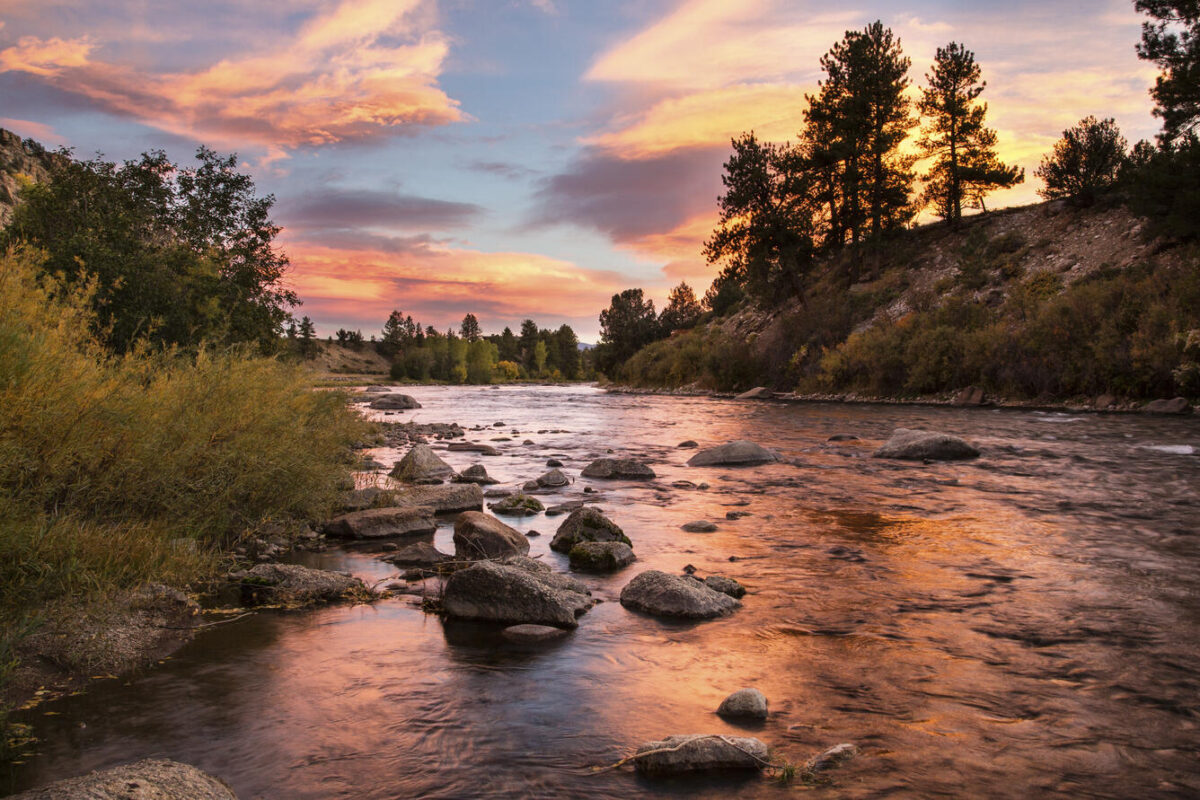
September on the Arkansas River feels different.
The river is quieter. Mornings are cooler. Cottonwoods begin hinting at fall. Summer crowds thin out, campsites become easier to enjoy, and the frantic pace of June and July gives way to a season that rewards slowing down.
It is also one of the most interesting times to explore the entire Arkansas River corridor.
Upstream around Leadville and Twin Lakes, nights can already feel like fall. Buena Vista and Browns Canyon remain comfortable for hiking, biking, fishing, camping, and river trips. Salida still feels lively without quite as much midsummer traffic. Downstream through Bighorn Sheep Canyon and Cañon City, lower elevations stretch the warm-weather season even farther.
If your idea of an Arkansas River trip includes more than simply rafting a rapid and driving home, late August through September may be the sweet spot.
The Arkansas River Does Not Shut Down After Summer
Colorado’s mountain recreation calendar can create the impression that everything ends after August.
It doesn’t.
Colorado Parks and Wildlife manages the Arkansas Headwaters Recreation Area along 152 miles of river, and the recreation season simply changes character as summer winds down.
Whitewater boating peaks during the higher-water portion of the season, while Colorado Parks and Wildlife notes that fishing becomes increasingly important as flows drop in late summer and early fall. Camping, hiking, biking, wildlife watching, scenic driving, and exploring the river towns continue well beyond the busiest summer weeks.
The result is a particularly good time for travelers who want to mix several activities instead of building an entire vacation around one.
You can check current Arkansas River flows before your trip and use the Arkansas Headwaters Recreation Area for current recreation information, closures, access details, and regulations.
Fishing Gets Better as the River Settles Down
If there is one activity especially well suited to the seasonal transition, it is fishing.
Colorado Parks and Wildlife describes the Arkansas as a world-class trout fishery and says more than 100 miles of the river from the Lake Fork confluence downstream to Parkdale have been designated Gold Medal trout water.
The fishery is dominated by naturally reproducing brown trout, with rainbow trout also present.
Late summer generally brings lower, clearer water than the runoff season. That can make wading easier in appropriate locations and gives anglers a better look at the river’s structure, including seams, pockets, riffles, pools, and runs that were hidden under higher water earlier in the year.
There is another advantage.
Colorado Parks and Wildlife notes that most whitewater boating takes place from mid-morning through mid-afternoon and that fishing is often best early and late in the day. As the main rafting season winds down, anglers increasingly become the dominant river users on many sections.
The stretch from Salida downstream through Bighorn Sheep Canyon is especially approachable. Highway 50 follows the river closely, and numerous Arkansas Headwaters Recreation Area sites provide public access.
The Buena Vista-to-Salida corridor also contains public access and fishing easements, although private land is mixed throughout the valley. Never assume that being next to the river means you have permission to access it.
Use the Colorado Fishing Atlas and the Arkansas River Guide fishing page to plan access before you go.
Lower Water Does Not Mean No Rafting
September rafting is different from June rafting, and that is not necessarily a bad thing.
Colorado Parks and Wildlife says the primary whitewater season begins with spring runoff and continues into late summer or early fall as flows decrease.
At lower flows, rocks and channels become more pronounced, some sections become more technical, and outfitters may adjust the sections they run based on water levels and current conditions.
That means you should not judge a September rafting trip by what the river looked like in June.
Some stretches remain fun and worthwhile at lower water, while others may no longer be practical for a particular type of boat or commercial trip.
The solution is simple: check current conditions rather than relying on a calendar.
Our Arkansas River rafting guide explains the major sections, while the river flow page provides gauges for Granite, Nathrop, Wellsville, and Parkdale.
Those gauges matter because the Arkansas is not one uniform river. A flow that works well in one section can feel completely different somewhere else.
Browns Canyon Becomes a Different Kind of Destination
Browns Canyon National Monument is famous for whitewater, but the canyon is much bigger than rafting.
As the river season quiets down, it becomes easier to appreciate the surrounding landscape itself.
Brown granite formations rise above the Arkansas, while pinyon-juniper woodland, open slopes, and rugged side canyons provide habitat for bighorn sheep, mule deer, raptors, and other wildlife.
River access around Ruby Mountain and Hecla Junction can serve as a starting point for fishing, camping, hiking, picnicking, or simply spending an afternoon beside the Arkansas.
September also brings cooler temperatures for hiking than the hottest part of summer.
If you head into Browns Canyon away from developed recreation sites, remember that this is rugged public land rather than a manicured park. Carry water, download maps before leaving cell service, watch the weather, and know where public land ends.
Check the Bureau of Land Management’s Browns Canyon National Monument information before heading out.
Camping Gets Better When the Nights Get Colder
This depends on your definition of better.
If you need warm nights and flip-flop weather at breakfast, July wins.
If you like cool sleeping weather, fewer mosquitoes, quieter evenings, campfires when and where current restrictions allow them, and mornings that actually make coffee feel necessary, September is hard to beat.
The key is remembering how much elevation changes the season.
Camping near Leadville or Twin Lakes is very different from camping near Cañon City.
High-elevation nights can become legitimately cold by September. Frost is possible, and an early-season storm can make the mountains look like winter even while lower elevations remain pleasant.
Farther downstream around Salida, Cotopaxi, Bighorn Sheep Canyon, and Cañon City, daytime temperatures often remain much more comfortable later into the season.
That elevation gradient gives you options.
If the high country turns cold, move downstream.
Our Arkansas River camping guide compares the major camping areas from Leadville to Cañon City.
Fire restrictions can change quickly in late summer and fall. Arkansas Headwaters Recreation Area campgrounds follow applicable federal and county restrictions, with the most restrictive rule applying. Check current restrictions for the exact location where you plan to camp before lighting a fire or using equipment that may be restricted.
September Is Scenic-Drive Season
One of the best reasons to visit the Arkansas River Valley in September is that you do not have to spend every day doing something strenuous.
Sometimes the right move is to get in the vehicle and see where the road goes.
Independence Pass
From Twin Lakes, Highway 82 climbs to the Continental Divide at 12,095 feet before descending toward the Independence ghost town, the Grottos, and Aspen.
It is one of the most spectacular paved drives connected to the Arkansas River Valley.
September can add fall color to the route, but Independence Pass is a high mountain road and weather can change quickly. Always check current conditions before leaving.
Our Independence Pass driving guide covers the route and worthwhile stops in detail.
Cottonwood Pass
West of Buena Vista, Cottonwood Pass climbs through the Collegiate Peaks to the Continental Divide.
The drive makes an easy addition to a Buena Vista trip and offers access to alpine scenery, trails, lakes, and high-country fall color.
If you are staying in the middle of the valley, see our Buena Vista guide for more ways to combine the drive with river access, hiking, biking, hot springs, and downtown.
Highway 50 Through Bighorn Sheep Canyon
You do not need to climb a mountain pass to find a great scenic drive.
Highway 50 follows the Arkansas downstream from Salida through Bighorn Sheep Canyon toward Cotopaxi and the Royal Gorge region.
The scenery changes dramatically as the broad Upper Arkansas Valley narrows into dry canyon country. River access sites along the route make it easy to stop for fishing, a picnic, wildlife watching, or a walk beside the water.
Keep an eye on the rocky hillsides for bighorn sheep.
Use our Cotopaxi guide as a starting point for exploring this part of the river.
Fall Color Does Not Arrive Everywhere at Once
Trying to predict Colorado’s exact peak fall-color date months in advance is a good way to be wrong.
Elevation, temperature, moisture, wind, and individual stands of trees all influence when leaves change.
That uncertainty actually works in your favor along the Arkansas River corridor.
The landscape stretches from high mountain country around Leadville and Twin Lakes to much lower elevations around Cañon City. Fall therefore moves through the corridor rather than arriving everywhere on the same weekend.
Higher country usually changes first.
As September progresses, color tends to work downward into the valleys and lower elevations.
A trip that includes Twin Lakes, Buena Vista, Chalk Creek, Salida, and Bighorn Sheep Canyon gives you several elevations to explore instead of betting everything on one famous aspen grove.
And remember that fall on the Arkansas is not just about aspens.
Cottonwoods along the river turn brilliant yellow and gold, particularly later in the season and at lower elevations.
Salida Makes an Excellent Fall Basecamp
Salida works particularly well when the weather becomes less predictable because you do not have to commit to a full day in the backcountry.
The Arkansas River runs directly through downtown.
You can fish in the morning, ride or hike nearby trails, wander the historic district, eat lunch, and still have time for a drive through Bighorn Sheep Canyon or toward Monarch Pass.
If a cold front rolls over the high peaks, there is plenty to do at lower elevation.
That flexibility becomes increasingly valuable as summer turns toward fall.
See the Arkansas River Guide to Salida for more trip ideas.
Do Not Ignore Cañon City
Travelers based around Buena Vista and Salida sometimes treat Cañon City as the place where the mountain trip ends.
In fall, it can be where the warm-weather trip continues.
The Arkansas emerges from the Royal Gorge into a substantially lower landscape around Cañon City. The river becomes gentler downstream, cottonwoods line portions of the corridor, and the Arkansas Riverwalk provides an easy way to explore the river without committing to a major hike.
The Royal Gorge region also offers hiking, biking, climbing, scenic overlooks, and a completely different geological setting from the Upper Arkansas Valley.
If an early cold snap hits Leadville or Buena Vista, heading downstream can sometimes buy you an entirely different day.
Wildlife Watching Improves When You Slow Down
The Arkansas River Valley supports wildlife year-round.
Colorado Parks and Wildlife lists mule deer, pronghorn, and bighorn sheep among the animals living in the valley, with elk and moose also occurring in the region.
The river corridor supports an impressive variety of birds too, including golden eagles, bald eagles, peregrine falcons, blue herons, turkey vultures, ducks, geese, mergansers, and American dippers.
Bighorn Sheep Canyon is an obvious place to watch the rocky slopes, while Browns Canyon also provides important bighorn habitat.
Wildlife sightings are never guaranteed.
Bring binoculars anyway.
September encourages exactly the kind of travel that produces good wildlife encounters: slower drives, quieter camps, longer stops beside the river, and fewer reasons to race toward the next activity.
A Simple Four-Day September Arkansas River Trip
You could spend weeks exploring the corridor, but four days is enough to experience how varied it is.
Day 1: Leadville and Twin Lakes
Explore Leadville, drive south to Twin Lakes, and spend the afternoon around the water. If the weather is stable and the road is open, add part or all of the Independence Pass drive.
Day 2: Buena Vista and Browns Canyon
Spend the morning fishing, rafting if current conditions and available trips make sense, hiking, or biking. Explore Buena Vista later in the day and consider a hot-springs soak in the evening.
Day 3: Salida
Walk downtown and along the Arkansas, fish early or late, ride local trails, and use the middle of the day for lunch, galleries, shops, or a scenic drive.
Day 4: Bighorn Sheep Canyon to Cañon City
Follow Highway 50 downstream through Cotopaxi and Bighorn Sheep Canyon. Stop at river access areas, look for wildlife, and continue toward the Royal Gorge and Cañon City.
In four days, you will have traveled from Colorado’s high mountain headwaters country toward a much warmer, drier canyon landscape without ever really leaving the Arkansas River.
What to Pack for September
Late summer and early fall reward flexible packing.
- Warm layers for mornings and evenings
- A rain shell
- Sun protection
- Plenty of drinking water
- Binoculars for wildlife
- Offline maps for mountain and public-land areas
- Warmer camping gear than you would bring in July
- Fishing gear and a current Colorado fishing license if you plan to fish
- Clothing for both warm afternoons and near-freezing high-country mornings
Most importantly, do not let a warm forecast in Cañon City convince you that it will be warm at Twin Lakes or on the Continental Divide.
Elevation matters here.
Frequently Asked Questions
Is September a good time to visit the Arkansas River Valley?
Yes. September can be excellent for fishing, camping, hiking, biking, scenic drives, wildlife watching, hot springs, and exploring towns. Rafting opportunities become more dependent on river flow, river section, boat type, and outfitter operations as water levels decline.
Can you still raft the Arkansas River in September?
Sometimes. Colorado Parks and Wildlife describes the primary boating season as extending into late summer or early fall as flows decrease. Actual commercial trip availability depends on current water levels and the river section, so check directly with outfitters rather than assuming a section is running.
Is September good for fishing the Arkansas River?
It can be one of the more appealing times of year. Colorado Parks and Wildlife notes that fishing improves as flows become lower and clearer, and fishing use increases before and after the high-water period.
When do fall colors peak along the Arkansas River?
There is no reliable single peak date for the entire corridor. Higher elevations around Leadville, Twin Lakes, and the mountain passes generally change before lower areas around Salida, Bighorn Sheep Canyon, and Cañon City. Weather can shift the timing from year to year.
Does it get cold in September?
Yes, particularly at higher elevations. Nights around Leadville, Twin Lakes, and high mountain campgrounds can become very cold, while lower elevations around Salida and Cañon City may remain comparatively mild. Bring layers and check the forecast for the specific elevation you plan to visit.
Summer Ending Does Not Mean the Arkansas River Is Done
The Arkansas River Valley does not have one season.
It has a progression.
Runoff gives way to summer whitewater. Summer gives way to clearer water, cool mornings, fishing, quieter camps, yellow cottonwoods, mountain drives, and eventually snow returning to the high peaks.
September sits right in the middle of that transition.
You can still spend a warm afternoon beside the river, then wake the next morning to frost on your tent and fresh snow high on the Sawatch Range.
You can fish in Salida, look for bighorn sheep downstream, drive into the high country, soak in hot springs, camp beside the Arkansas, or simply sit by the river without feeling like you need to be somewhere else.
That is what makes this time of year so good.
The river is still here.
You just get a little more room to enjoy it.
Plan Your Arkansas River Trip
Use Arkansas River Guide to follow the river from Leadville through Buena Vista, Browns Canyon, Salida, Bighorn Sheep Canyon, the Royal Gorge, and Cañon City. Check current river flows, compare camping areas, explore rafting sections, and build a trip around the part of the Arkansas that fits the season.